Payments overview – checked 22 September 2026
SpinBond Payments in AUD: Deposits, Withdrawals and Verification
 Available in AU
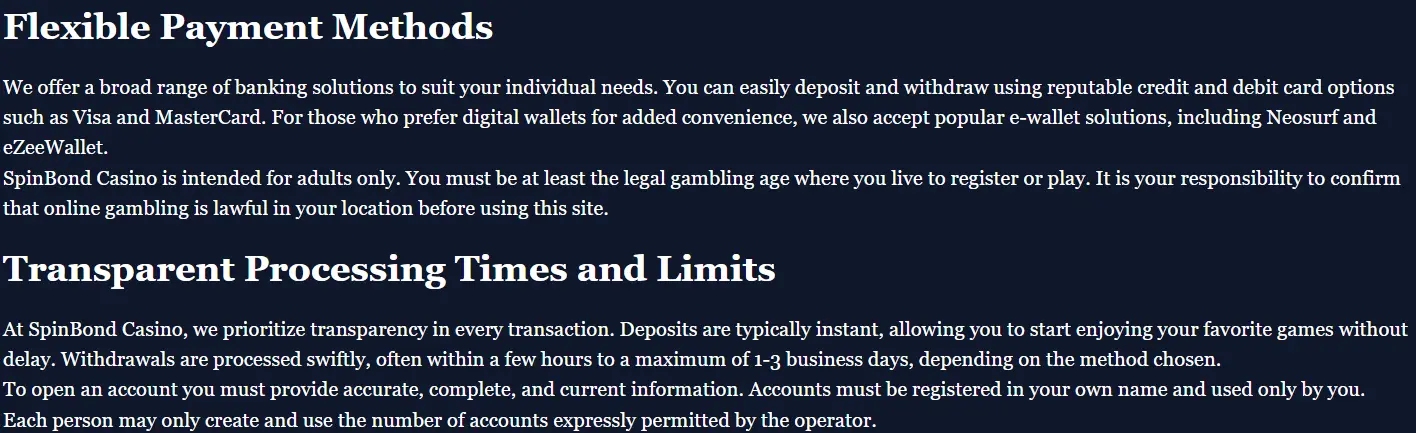
SpinBond’s current official terms list Australian dollars as a supported currency and name Bitcoin, eZeeWallet, Mastercard, Neosurf and Visa among its payment options. The same terms say availability depends on location and the selected method. That distinction matters: a method appearing on a global payment list is not proof that it is available to every Australian account.
For Australian readers, there is also a gap between common local payment habits and what SpinBond currently verifies. Cards are widely used in Australia and SpinBond lists Visa and Mastercard. PayID is also widely adopted in Australia, but SpinBond’s current published material does not verify PayID support. This guide therefore separates operator-confirmed methods from Australian market context rather than treating them as the same thing.

Table of Contents
- Verified SpinBond payment facts at a glance
- Deposits and withdrawals should be treated as separate workflows
- Australian payment habits are context, not proof of cashier support
- PayID: strong Australian demand, unverified SpinBond support
- What the listed methods imply – and what they do not
- Why exact limits, fees and times are omitted here
- Payment support is separate from licence status
- How to compare the five verified methods without inventing a ranking
- What should trigger an update to this payments page
- Where SpinBond’s verified cashier options fit Australian payment habits
Verified SpinBond payment facts at a glance
The most useful starting point is the short list of claims that can be tied directly to current SpinBond material. AUD is supported. The listed payment methods are Bitcoin, eZeeWallet, Mastercard, Neosurf and Visa. SpinBond also states that payment availability can vary by location and method. Those are product-level facts; they do not establish that every method is usable by every Australian visitor or account.
| Item | Verified status | What not to infer |
|---|---|---|
| AUD | Supported currency | Currency support is not evidence of Australian licensing. |
| Bitcoin | Listed payment option | Do not assume identical deposit and withdrawal rules. |
| eZeeWallet | Listed payment option | Availability can vary by location. |
| Mastercard | Listed payment option | A global card listing does not guarantee every Australian issuer will permit a transaction. |
| Neosurf | Listed payment option | Do not infer withdrawal support from deposit support. |
| Visa | Listed payment option | Method-level limits and fees should be checked in the live cashier. |
| PayID | Not verified for SpinBond | High Australian usage does not prove operator support. |
Deposits and withdrawals should be treated as separate workflows
A payment method can appear in an operator’s general payments list without behaving the same way for deposits and withdrawals. The funding step is usually about getting money into an account, while a cashout can additionally depend on identity checks, source-of-funds questions, prior deposit routes and payment-provider rules. SpinBond’s terms say withdrawal requests can be reviewed and transactions can be paused while reasonable checks are completed.
That is why this parent page avoids publishing one universal processing time, fee or limit for all methods. Exact withdrawal limits, method-specific processing times and fees are high-risk details that should come from current official payment screens or terms. They should not be copied from an affiliate table and presented as a fixed SpinBond rule.
For funding-only detail, use the SpinBond deposits. For cashout mechanics and verification issues, use the SpinBond withdrawals.
Australian payment habits are context, not proof of cashier support
The Reserve Bank of Australia’s 2025 Consumer Payments Survey shows how strongly Australian consumers favour electronic payments. Cards represented about 73% of consumer payments in 2025. Debit cards alone accounted for almost half of payments, and cards remained widely used across transaction sizes.
The same RBA research shows strong PayID adoption: around 80% of surveyed consumers knew about PayID and around 50% had used it during the previous year. That makes PayID a sensible question for an Australian payment page, but it does not create a SpinBond feature. A reader-interest signal and a market-preference signal are not substitutes for operator evidence.
Evidence rule for local methods
If a payment method is popular in Australia but is absent from SpinBond’s current verified material, this guide labels the method unverified rather than filling the gap from competitor casinos or general market knowledge.
PayID: strong Australian demand, unverified SpinBond support
PayID deserves its own explanation because Australian users commonly recognise it as a fast account-to-account payment service. It lets a payer use an identifier such as a mobile number or email address rather than manually entering bank account details. Its adoption has grown substantially in Australia, so users may reasonably expect to see it discussed in a local payments guide.
SpinBond’s current verified list, however, names Bitcoin, eZeeWallet, Mastercard, Neosurf and Visa. Current official sources do not show that PayID is available. This page therefore does not state or imply PayID support. If a live SpinBond cashier later displays PayID for an Australian account, that would be new evidence and the page should be updated from that direct observation.
This distinction prevents a common review-site error: assuming that because a payment service is popular in a country, a particular operator must offer it. Local relevance can justify research, but only current operator evidence can justify the product claim.
What the listed methods imply – and what they do not
Visa and Mastercard fit familiar Australian card-payment behaviour, while Bitcoin, eZeeWallet and Neosurf represent alternative rails with different characteristics. That makes SpinBond’s public list broader than a simple card-only cashier, but the list still needs to be read conservatively.
| Method | What is confirmed | What remains page-level or account-level |
|---|---|---|
| Visa | SpinBond lists Visa. | Issuer acceptance, exact deposit limit, withdrawal routing and fees. |
| Mastercard | SpinBond lists Mastercard. | Issuer acceptance, exact limits and whether cashouts return to the same card. |
| Bitcoin | SpinBond lists Bitcoin and Bitcoin as a supported currency option. | Network requirements, minimum transaction size and cashout timing. |
| eZeeWallet | SpinBond lists eZeeWallet. | Australian account availability and current cashier limits. |
| Neosurf | SpinBond lists Neosurf. | Whether it is deposit-only in a particular account and any redemption constraints. |
The practical point is not that these methods are equivalent. It is that the verified public evidence supports their presence in SpinBond’s payment list, while exact transactional behaviour still belongs to the live cashier or current official method-specific terms.
Why exact limits, fees and times are omitted here
Exact limits and timings can be among the fastest-moving payment facts on a casino site. A cashier can show different limits by currency, account status, verification status, country or payment rail. A withdrawal request can also involve review before the external provider or banking system begins its part of the transaction.
SpinBond’s current terms explicitly say that processing times, limits and fees vary by method and by whether verification checks have been completed. That wording supports the existence of variation, not a single numeric table. Publishing one precise number without a current method-level source would create false certainty.
The same approach applies to KYC. Verification can affect transactions, but this payments overview does not invent a document checklist or a processing deadline. The SpinBond account and KYC handles identity requirements separately using its own evidence boundaries.
Payment support is separate from licence status
AUD support and the presence of familiar payment methods should not be read as evidence that SpinBond holds an Australian gambling licence. Product configuration, local currency support and payment rails answer different questions from regulatory authorisation. This site keeps those evidence tracks separate.
For the licensing record and player-protection evidence, see SpinBond licence and trust. The purpose of that separation is simple: a cashier feature can be factually real even when it says nothing about the legal status of the operator in a particular jurisdiction.
How to compare the five verified methods without inventing a ranking
The five names on SpinBond’s current list represent different payment rails, so a useful comparison focuses on questions the live cashier can answer rather than assigning a universal winner. For cards, the practical checks are whether the specific card is accepted, what amount range the cashier displays and whether the issuer permits the transaction. For Bitcoin, the important variables include the wallet address, network instructions, exchange-rate exposure and the amount shown before confirmation. For eZeeWallet and Neosurf, the relevant question is whether the service appears for the account and whether it is available for both funding and cashout.
This method-by-method approach is more reliable than copying a generic table of speed labels such as “instant” or “fast”. A payment can appear instantly in one stage while a later withdrawal follows a different route or waits for account review. The current SpinBond terms themselves say that processing can depend on verification and third-party providers, so a universal time promise would go beyond the evidence.
It is also worth separating convenience from consumer protection. A familiar card logo or a locally denominated AUD account may make a cashier easier to understand, but neither tells a reader which dispute scheme applies or whether a gambling service has local regulatory approval. Those are separate questions with separate sources.
What should trigger an update to this payments page
Payment pages age quickly because cashiers are operational interfaces rather than static product catalogues. This page should be rechecked when SpinBond adds or removes a method, changes the currencies shown in its official material, publishes method-specific limits, or exposes a new local option such as PayID. The live cashier is the strongest account-level evidence of which choices are actually presented at a given time.
An update should also preserve the difference between observation and inference. If PayID appears in a current Australian cashier, the claim can move from unverified to directly observed. If a third-party review merely adds PayID to a list without corresponding SpinBond evidence, the status should not change. The same rule applies to bank transfer labels, crypto networks and card variants.
Where SpinBond’s verified cashier options fit Australian payment habits
SpinBond’s verified payment picture is clear at the broad level: AUD is supported, and its official material lists Bitcoin, eZeeWallet, Mastercard, Neosurf and Visa, with availability varying by location and method. Australian market data makes cards especially relevant context, while PayID’s strong adoption explains why users search for it.
The key boundary is equally clear. Market popularity is not product evidence. Until SpinBond itself exposes PayID in a current cashier or official payment page, PayID remains an Australian expectation rather than a verified SpinBond method. For practical use, the live cashier should be treated as the final source for account-specific availability, limits and fees. This should be rechecked whenever the cashier changes materially.
For the broader brand context, see the SpinBond Australia review.
Prepared by the Spinbond Casino editorial staff.