Account guide · verified 22 September 2026
SpinBond Account, Registration and KYC Requirements
 Available in AU
SpinBond’s current account rules say users must be adults who meet the legal gambling age where they live, and that location restrictions can apply. The operator can also require verification. For this Australian guide, the evidence supports those broad account and KYC boundaries, but it does not support a fixed document checklist or a guaranteed verification time.
The useful distinction is between confirmed account rules and details that remain account-specific. Eligibility, account information, verification, withdrawals and support can be described where current sources support them, while unverified specifics should remain unstated. The broader SpinBond Australia review covers the rest of the brand; this page stays with account operations and evidence limits.

Table of Contents
- What SpinBond currently says about account eligibility
- Registration information should be accurate and account-specific
- Where KYC fits into a SpinBond account
- What is verified and what remains account-specific
- Support routes for account and verification questions
- Account verification is not the same as bonus eligibility
- How to assess a verification request without relying on a copied checklist
- Why account evidence should be dated and source-specific
- Why account rules and KYC evidence should stay separate
- Where SpinBond account rules leave Australian users needing fresh verification
What SpinBond currently says about account eligibility
SpinBond’s current terms frame account use around adulthood, lawful use in the user’s location, accurate account information and the possibility of verification. They also say access can be restricted in some countries or regions. These are general account rules, not proof that a particular legal regime authorises the service in Australia.
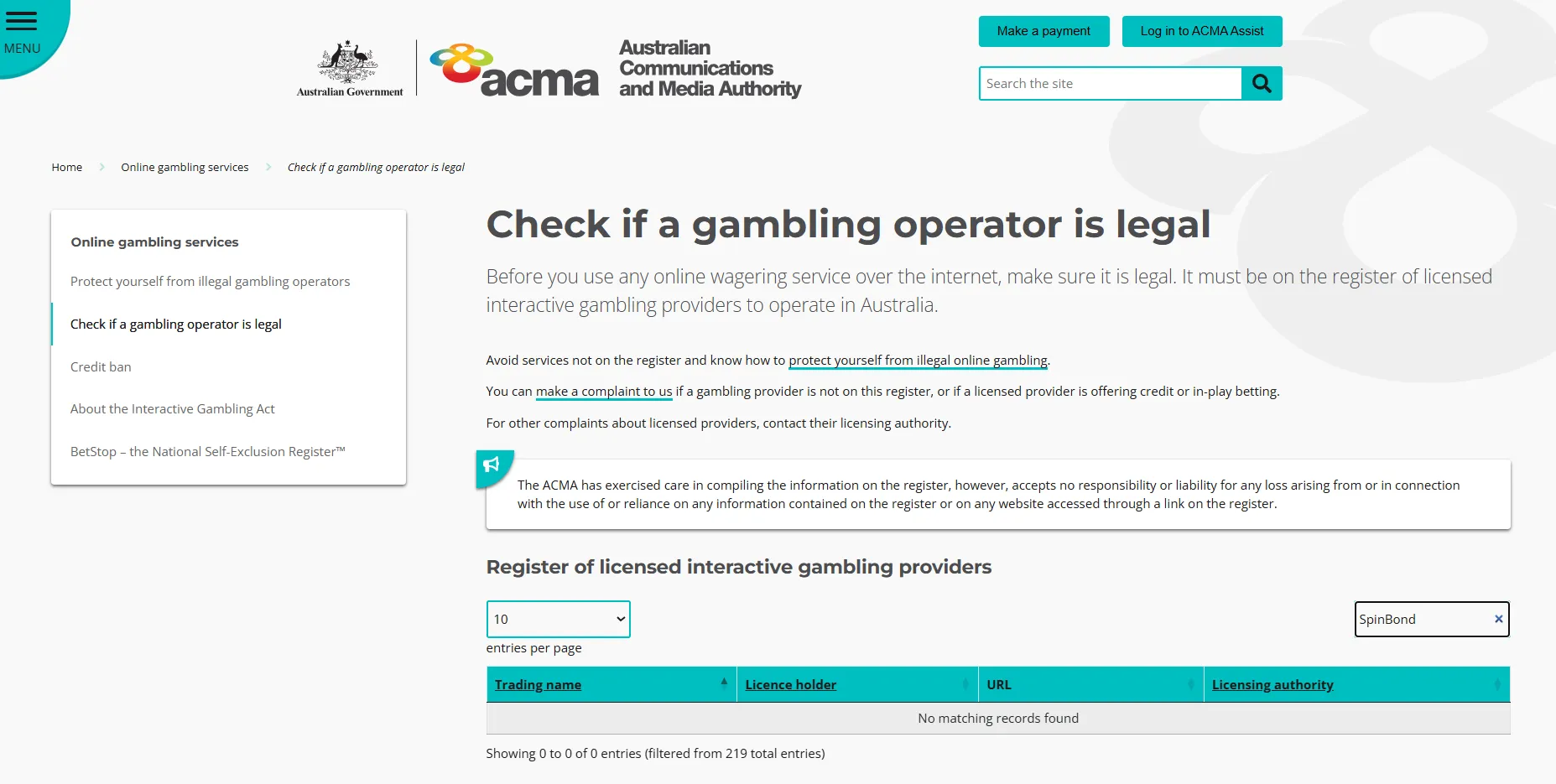
Account acceptance and Australian licensing are different questions. A registration form being visible, an AUD option being present, or an account process functioning does not establish a local licence. The dedicated SpinBond licence and trust page handles licence evidence and player-protection context separately.
For readers, the useful takeaway is to distinguish what an operator’s account terms require from what local law or regulation allows. The account rules described here are limited to what current sources support.
Registration information should be accurate and account-specific
The official terms say account details should be accurate, complete and current, and that the account should be registered in the user’s own name. They also reserve the ability to ask for account details to be verified or updated. That makes accuracy part of the account rule set rather than a cosmetic profile preference.
This guide does not reproduce a step-by-step sign-up funnel or tell readers how to bypass a location restriction. It also does not promise immediate approval. Registration interfaces change, and an account may move from initial creation to later verification without that sequence being identical for every user.
When a registration page requests information, the reliable reference is the field set shown on the current official interface. Field names, consent text and verification prompts can change, so older or reconstructed interfaces should not be treated as current.
Where KYC fits into a SpinBond account
Current official terms state that withdrawals may be subject to identity or compliance checks before processing. SpinBond’s current terms also describe identity, age, address and payment-method ownership as categories that can be checked. These categories explain the purpose of KYC without proving a fixed list of documents.
That distinction is important. A category such as “identity” does not prove that every user must upload the same identity document. Likewise, “address” does not establish one mandatory proof-of-address format. The exact request can depend on the account and should be taken from the secure verification process or a current official instruction.
The withdrawal-specific consequences are covered on SpinBond withdrawals. In account terms, the operational point is that required verification can limit services until checks are completed. This guide does not attach an unsupported number of minutes, hours or days to that process.
What is verified and what remains account-specific
| Account question | Evidence position | Practical implication |
|---|---|---|
| Adult/legal-age requirement | Supported by current official terms | State the general requirement without inventing a separate SpinBond age for Australia. |
| Location restrictions | Supported in general terms | State that restrictions can apply, without turning this into a claim of Australian licensing. |
| Verification can be requested | Supported | Explain the purpose and operational effect. |
| Verification can affect withdrawals | Verified in current sources | State directly. |
| Exact KYC documents | Not verified as a fixed list | Do not publish a checklist as universal. |
| Exact verification time | Not verified | Do not promise immediate or same-day approval. |
The table keeps broad rules separate from high-risk specifics. This is a stronger basis for an account guide than copying a checklist from another casino or from an older review and presenting it as current SpinBond policy.
Support routes for account and verification questions
Email support is verified at [email protected]. SpinBond’s current contact page references live chat and an online contact form, with availability varying. These routes can be useful when an account holder needs clarification about a verification request, account access, or a transaction-related issue.
Email is the clearest support channel when a written record matters. Live chat may be convenient when it is available, while the contact form provides a site-based route for a general inquiry. This guide does not claim fixed response times because the current official material checked does not establish them.
Support should also not be treated as a substitute for source verification. A promotional claim on another page, an affiliate statement, or an old site view does not become current merely because support exists. The useful role of support is to clarify the account’s current instruction when the public pages do not safely establish a specific detail.
Account verification is not the same as bonus eligibility
Account rules and promotional rules can overlap, but they answer different questions. KYC may affect whether an account can use certain services or complete a withdrawal, while a promotion can have separate eligibility and wagering conditions. Readers checking an offer should use the SpinBond bonus terms page rather than assuming that account verification alone settles promotional eligibility.
This separation also reduces a common source of confusion: completing identity checks does not prove that every promotion applies, just as seeing a promotion does not prove that every account or location qualifies. Each claim needs its own current evidence.
How to assess a verification request without relying on a copied checklist
The safest way to interpret a SpinBond verification request is to start with the instruction shown inside the account or in a direct official message. Confirm what category is being checked, what secure upload route is specified, and whether the request is linked to account information or a payment event. Avoid sending sensitive material through an unrelated channel simply because a third-party guide lists it.
A useful public guide can explain the categories and why verification matters, but it should not pretend to know the exact request before the operator makes it. A universal passport, licence, utility-bill or bank-statement combination is not stated because current sources do not establish one fixed list.
The same principle applies to timing. Verification can be operationally important without a reliable universal turnaround. A promised speed would be more precise than the evidence allows, so no fixed processing estimate is published here.
Why account evidence should be dated and source-specific
Account rules are especially vulnerable to becoming stale because operators can change registration fields, verification wording and support workflows without changing the overall purpose of the process. A useful review should therefore distinguish durable rules from interface details. The durable rules supported here are that users must meet the applicable age requirement, location restrictions can apply, account information must be accurate, and verification can be required. A specific field label, upload screen, response time or document request should be treated as current only when it is visible in a fresh official source.
A dated site view shows what the site displayed at a particular time; it does not prove that every later account sees the same sequence. When the interface changes, the correct response is to refresh the evidence rather than preserve an outdated step-by-step flow.
Why account rules and KYC evidence should stay separate
Account eligibility rules describe who can hold and use an account, while KYC evidence describes what the operator can ask to verify that account. Keeping those two layers separate prevents a general eligibility rule from being turned into an invented document checklist or a promised verification time. For Australian readers, the practical value is clarity about what is documented and what still needs a current account-level check.
Where SpinBond account rules leave Australian users needing fresh verification
The current evidence is enough to describe the framework: users must meet the applicable legal age, location restrictions can apply, account information should be accurate, verification can be requested, and withdrawal processing may depend on compliance checks. Email support is verified, and live chat plus a contact form are referenced as additional routes.
The unresolved details are the ones that should remain account-specific: the exact KYC document set, the exact verification duration, and any current interface fields or restrictions that change by location or account state. An Australian reader should rely on the live account instruction for those specifics rather than a static checklist. Keeping those boundaries visible is the central value of this account guide. Account-specific instructions should always take priority over older summaries.
For the broader brand context, see the SpinBond Australia review.
Written by the editors at Spinbond Casino.